
Pole Mounted Transformer Applications: 9 Common Uses in Power Distribution
Pole mounted transformers supply homes, farms, businesses, and remote facilities from overhead distribution lines. They are also part of networks that serve rooftop solar installations and electric vehicle (EV) chargers. Their basic job is straightforward: step distribution voltage down to the level customers need, close to where the electricity will be used.
The choice of transformer, however, changes with the application. A residential street depends on diversified household demand; an irrigation system may be governed by motor starting; and a neighborhood with rooftop solar and EV charging must account for power flowing in both directions. Below are nine common pole mounted transformer applications, with the benefits, configuration considerations, and illustrative examples that matter to utility engineers, EPC contractors, and buyers.
Engineering note: Every case in this article is an illustrative design scenario, not a documented Kerun installation. Suggested ratings are preliminary candidates, not approved designs. Final selection requires site-specific load, voltage, protection, mechanical, and utility reviews.
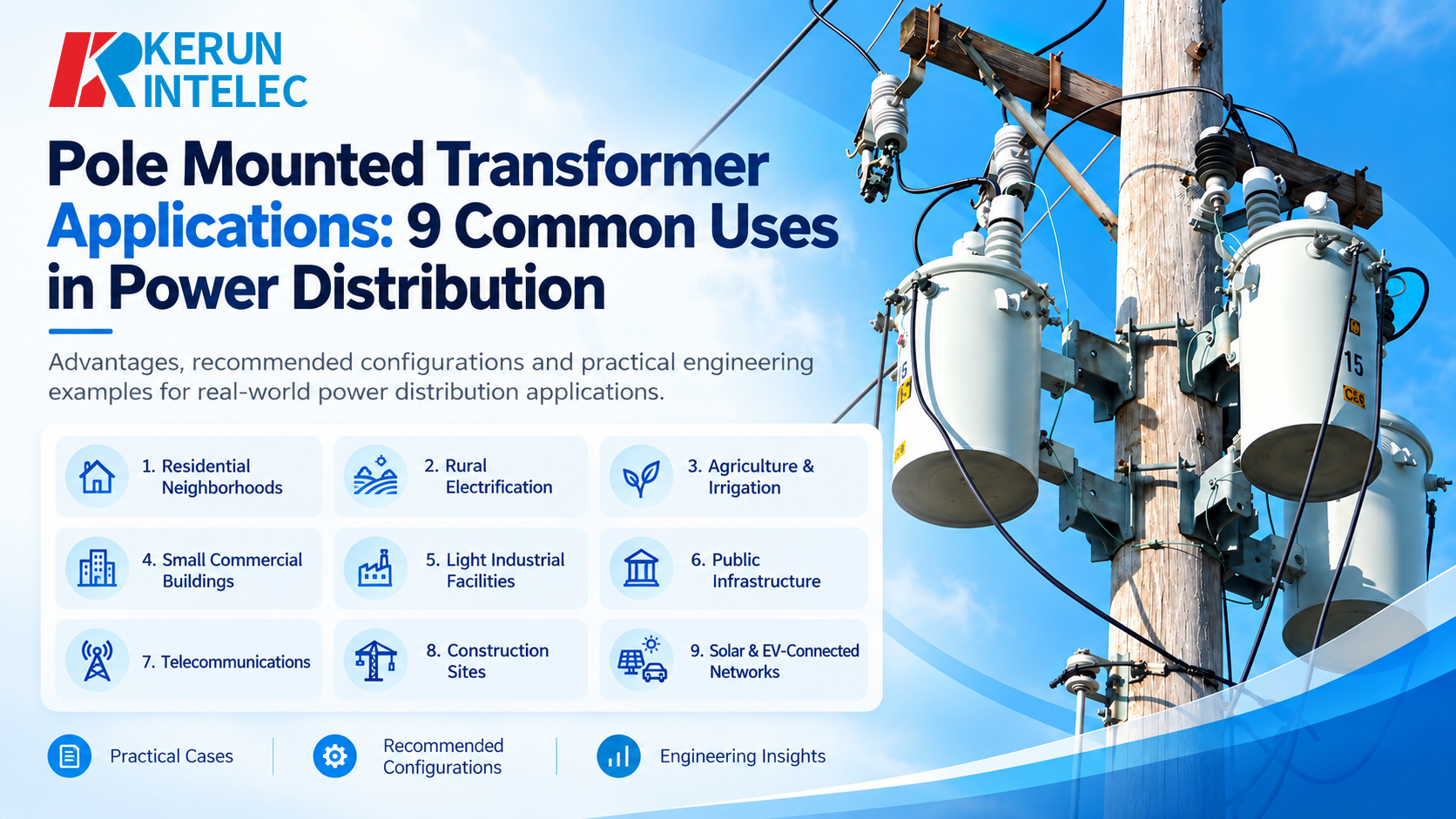
Pole Mounted Transformer Applications at a Glance
| Application | Main advantage | Key technical consideration |
|---|---|---|
| Residential neighborhoods | Convenient supply from overhead feeders | Diversified demand and service voltage |
| Rural electrification | Local supply for dispersed customers | Feeder voltage drop and future growth |
| Agriculture and irrigation | Power closer to pumps and farm equipment | Motor starting and seasonal loading |
| Small commercial buildings | Connection to existing overhead networks | Peak demand and required phases |
| Light industrial facilities | Local distribution for suitable workshops | Motor loads, impedance, and phase balance |
| Public infrastructure | Supply for distributed municipal equipment | Protection and reliability |
| Telecommunications | Connection to remote sites | Continuous operation and backup |
| Construction sites | Temporary power near work areas | Changing loads and electrical safety |
| Solar and EV-connected networks | Use of existing distribution infrastructure | Reverse power flow and peak charging demand |
1. Residential Neighborhoods: Supplying Electricity to Homes
Residential streets are among the most familiar places to find a pole transformer. In an overhead distribution network, one unit may supply a single property or a group of neighboring homes. The transformer lowers the feeder voltage to the approved residential service voltage for lighting, appliances, air-conditioning, water heating, and other household needs.
The key sizing issue is diversified demand. Ten houses do not normally use every connected appliance at full output simultaneously. Utilities instead estimate the combined peak that is reasonably expected to occur. That estimate can change as households add air-conditioning, electric heating, or EV chargers—even when no new homes are connected. Secondary conductor length, voltage drop, and future service upgrades therefore deserve as much attention as the initial kVA rating.
Application Advantages
Mounting a transformer on an approved utility pole makes use of existing overhead infrastructure and avoids a separate ground-level transformer enclosure at the supply point. Positioning it near the customers can shorten low-voltage service runs and make targeted replacement or capacity upgrades more practical. These benefits depend on suitable pole strength, electrical clearances, and secondary network design.
Recommended Configuration
- Transformer: Single-phase conventional or completely self-protected (CSP) pole mounted transformer.
- Ratings to evaluate: 25, 37.5, 50, or 75 kVA, subject to utility loading practice.
- Secondary service: 120/240 V split-phase where applicable; other voltages according to the local network.
- Protection: Approved primary fusing and surge protection, or the specified integrated CSP arrangement.
- Check before selection: Diversified peak load, secondary voltage drop, pole capacity, and forecast growth.
Typical Application Case: Ten Homes Sharing a 50 kVA Transformer
Suppose a utility estimates a 38 kVA diversified peak for ten suburban houses. A 50 kVA single-phase transformer is a reasonable candidate for review, assuming its winding arrangement matches the required residential service. That choice cannot be confirmed from the house count alone: the utility still needs to check conductor voltage drop, hot-weather cooling demand, permissible loading, and planned EV charging.
If several residents intend to install high-power chargers, the future evening peak may justify a different rating or managed charging. The practical lesson is to size the transformer around the neighborhood’s load profile, not a fixed number of houses per unit.
2. Rural Electrification: Extending Power to Remote Communities
Rural electrification projects often serve homes and community facilities separated by long distances. Running a low-voltage circuit from one distant transformer can lead to substantial voltage drop and larger conductor requirements. Installing local overhead distribution transformers along a suitable medium-voltage feeder brings low-voltage supply closer to each group of customers.
This arrangement can be useful for villages, isolated housing clusters, schools, and small agricultural communities. Yet installing more transformers does not automatically solve a weak feeder. Voltage at the transformer location depends on the upstream circuit, while customer voltage also depends on the secondary lines. Future household connections, grounding, and the utility’s available primary connection must be considered from the beginning.
Application Advantages
Where overhead poles and feeders are suitable, pole-mounted units can provide local supply points without separate ground-level enclosures. They also fit established utility inspection and maintenance routes. Planning several smaller service locations can be practical for dispersed customers, provided the overall feeder design supports them.
Recommended Configuration
- Transformer: Single-phase pole mounted distribution transformer where a suitable single-phase service is available.
- Ratings to evaluate: 10, 15, 25, or 50 kVA.
- Primary and secondary connections: Match the utility’s actual feeder arrangement and local customer voltage.
- Protection: Utility-approved fusing, surge arresters, and grounding.
- Check before selection: Primary and secondary voltage drop, accessibility, lightning exposure, and future connections.
Typical Application Case: A Village with Seven Houses and a Community Building
An electrification scheme is planned for seven houses and one community building several kilometers from an established service area. The initial diversified peak is estimated at 18 kVA, so the design team considers a 25 kVA single-phase unit near the buildings.
Before committing, engineers must determine whether adequate primary voltage reaches that location at feeder peak load and whether the longest low-voltage service remains within the permitted voltage range. If more households are expected, a second supply point or a larger unit may be more appropriate than operating the initial transformer close to its limit. The transformer rating and feeder study need to support the same growth plan.
Where Kerun can help: For rural programs with multiple transformer locations, Kerun can help prepare consistent equipment schedules covering voltage ratings, mounting provisions, protection accessories, and project-specific specifications. This makes comparison and technical approval easier for utilities and EPC buyers.
3. Agriculture and Irrigation: Powering Pumps and Farm Equipment
Farms often need electricity far from the nearest commercial or residential load center. An overhead transformer can serve irrigation pumps, wells, grain-handling systems, ventilation fans, refrigeration equipment, and agricultural workshops when the utility network and site conditions permit.
Agricultural loads differ considerably from household loads. Irrigation motors may draw high current while starting, causing a short voltage dip even if their normal running demand is modest. Some equipment operates only during a growing season; other systems, such as refrigeration, need power throughout the year. Transformer capacity, losses, motor starting, cable length, and seasonal duty therefore need to be assessed together.
Application Advantages
A transformer positioned near a well or farm building can limit long low-voltage cable runs across fields and preserve ground space for vehicles and equipment. Several widely separated facilities may also be served from appropriately planned local supply points. Overhead mounting does not remove the need for safe clearances, mechanical protection, or suitable access for maintenance.
Recommended Configuration
- Transformer: Single-phase unit for compatible loads; approved three-phase unit or transformer bank for three-phase equipment.
- Ratings to evaluate: 25–100 kVA for suitable smaller farm installations.
- Secondary voltage: Match motor nameplates and the approved farm service.
- Protection: Coordinated transformer, feeder, and motor protection, with surge protection as required.
- Check before selection: Starting method and current, voltage dip, power factor, seasonal load, and conductor length.
A soft starter or variable-frequency drive may reduce starting stress where appropriate, but must be assessed as part of the complete motor system.
Typical Application Case: A 22 kW Irrigation Pump
A farm plans to operate a 22 kW three-phase pump motor together with controls, lighting, and small auxiliary loads. Suppose simultaneous running demand reaches 30 kW at a power factor of 0.85, giving approximately 35 kVA of apparent demand. With an approved three-phase overhead supply, a 75 kVA transformer arrangement may be assessed.
That apparent headroom does not settle the decision. The pump’s locked-rotor current and starting method can cause a voltage dip that affects other equipment. The engineer must check feeder strength, transformer impedance, and the motor-starting performance before confirming the rating. A single-phase feeder cannot be assumed to provide a conventional three-phase supply simply by installing a transformer.
4. Small Commercial Buildings: Power for Shops, Restaurants, and Offices
Small commercial properties frequently connect to the same overhead networks that supply nearby homes. A roadside store, restaurant, office, or service shop may be a good candidate for pole-mounted supply, provided its voltage, phase requirements, and peak demand match the available utility service.
Commercial buildings with similar floor areas can have very different electrical profiles. Offices may be dominated by lighting, computing, and cooling. Shops may operate refrigeration continuously, while restaurants can combine cooking, ventilation, refrigeration, and air-conditioning peaks. When several businesses share a transformer, the relevant figure is their coincident maximum demand, not simply the sum of their individual equipment ratings.
Application Advantages
A suitable overhead connection can conserve limited ground space on a busy commercial street and avoid creating a dedicated transformer enclosure for each small building. A local supply point can also make future replacement or capacity changes more manageable within the utility’s network plan.
Recommended Configuration
- Transformer: Single-phase conventional or CSP unit where appropriate; engineered three-phase arrangement if required.
- Ratings to evaluate: 25, 50, 75, or 100 kVA.
- Secondary service: Match the connected equipment and approved utility voltage.
- Protection: Coordinated primary and downstream protective devices.
- Check before selection: Coincident demand, refrigeration and HVAC starting, phase requirements, and expansion plans.
Typical Application Case: Three Businesses on One Supply Point
A convenience shop, small office, and service store have an estimated combined peak of 30 kW at 0.90 power factor, or about 33 kVA. A 50 kVA single-phase pole mounted transformer could be considered if all three tenants can use the approved single-phase service.
The design team must still assess compressor starts, voltage drop, and future equipment changes. If a tenant operates equipment requiring conventional three-phase power, the service arrangement must be reconsidered rather than assuming the proposed single-phase unit will meet every need. Matching the service to the equipment is as important as matching the kVA to the demand.
5. Light Industrial Facilities: Supplying Workshops and Small Manufacturers
Repair workshops, fabrication shops, and small processing facilities may be served by pole-mounted transformers where the utility allows overhead industrial service and the electrical and structural limits are satisfied. These sites typically have more demanding load behavior than homes or offices.
Compressors, welding equipment, machine tools, and variable-speed drives can produce short peaks, voltage fluctuations, and harmonic currents. A workshop with moderate average consumption may still need careful engineering if motors start together or sensitive equipment shares the supply. Transformer impedance, phase balance, protective-device coordination, and power quality may influence the solution more than nominal capacity alone. Larger or more demanding sites may be better served by pad-mounted equipment or a dedicated substation.
Application Advantages
Where permitted, overhead transformation provides a local supply connection while preserving ground space for workshop operations. It may also fit an existing utility feeder without requiring a separate ground-level transformer enclosure. Suitability still depends on support structure capacity, required electrical clearances, and the approved network arrangement.
Recommended Configuration
- Transformer: Utility-approved three-phase overhead unit or appropriately connected single-phase bank for three-phase loads.
- Ratings to evaluate: Approximately 75–150 kVA for suitable small sites, subject to local installation limits.
- Secondary voltage: Match machine requirements and utility standards.
- Protection: Coordinated overload, short-circuit, and motor protection.
- Check before selection: Motor starting, impedance, harmonics, phase balance, fault level, and pole strength.
Typical Application Case: A Mechanical Fabrication Workshop
A workshop operates cutting machines, a compressor, ventilation equipment, and small production tools. Its calculated maximum coincident demand is 45 kW at a 0.85 power factor, or approximately 53 kVA. Engineers might compare 75 and 100 kVA three-phase arrangements.
The final choice depends partly on the compressor’s starting behavior and acceptable voltage dip. The utility must also approve the transformer mounting arrangement and structural load. Choosing 100 kVA solely because it is larger would overlook the engineering factors that actually determine service quality.
Where Kerun can help: For industrial procurement, Kerun can prepare proposed technical data covering rated voltage, impedance, no-load and load losses, insulation requirements, and dimensions. These values let project engineers evaluate a specific offering rather than relying on the nameplate kVA alone.
6. Public Infrastructure: Streetlights, Traffic Signals, and Municipal Systems
Roadside and municipal equipment often needs electricity at many separate locations. Traffic signals, surveillance cameras, streetlighting control panels, illuminated signs, and monitoring stations may all require small local connections from overhead distribution lines.
Their power consumption is not necessarily large, but their operating requirements differ. Streetlights commonly follow predictable schedules; traffic signals and monitoring systems may run continuously. Sensitive control equipment also needs appropriate surge protection, grounding, and circuit protection. For critical systems, service continuity must be planned beyond the transformer itself.
Application Advantages
A pole-mounted supply point can serve dispersed public equipment without occupying valuable roadside ground space. Where poles already exist, the connection may be convenient for utility inspection and maintenance. Public access, weather exposure, and clearances require particular attention.
Recommended Configuration
- Transformer: Small single-phase overhead transformer.
- Ratings to evaluate: 5, 10, 15, or 25 kVA where offered and utility-approved.
- Secondary service: Match municipal equipment requirements.
- Protection: Approved fusing, surge protection, grounding, and downstream circuit protection.
- Check before selection: Continuous demand, environmental exposure, access, and backup requirements.
Typical Application Case: A Signalized Road Intersection
An intersection includes traffic controllers, cameras, illuminated signs, and monitoring equipment with an estimated maximum demand of 6 kW. Depending on power factor, utility ratings, and permissible loading, a 10 or 15 kVA single-phase transformer may be reviewed.
The project must also provide coordinated electrical protection and safe maintenance access. Because traffic signals are safety-critical, the authority may require a UPS or other backup system sized to its operating objective. A correctly rated transformer supplies normal power; it does not keep the intersection running during a feeder outage.
7. Telecommunications: Supplying Remote Towers and Communication Equipment
Cellular base stations, radio repeaters, and communication shelters are often located beside highways, on hillsides, or in rural areas where an overhead feeder is the nearest utility source. A pole mounted transformer can provide the low-voltage AC supply used by rectifiers, cooling equipment, lighting, and other site services.
Many telecom devices ultimately operate on DC power, but the site still needs a suitable AC service for conversion and support equipment. Unlike seasonal irrigation loads, communication sites may operate continuously. Transformer no-load losses, cooling peaks, and battery recharge following an outage can therefore influence both the rating and long-term operating cost.
Application Advantages
Local transformation can avoid unnecessarily long secondary cable runs to remote sites. It also preserves space for communication cabinets, batteries, generators, and access paths. The site must still have separately designed backup equipment if continuity during an outage is required.
Recommended Configuration
- Transformer: Single-phase pole mounted transformer when the site accepts single-phase service.
- Ratings to evaluate: 10, 15, 25, 37.5, or 50 kVA.
- Secondary service: Match rectifiers, cooling, and auxiliary distribution equipment.
- Protection: Coordinated protection, grounding, and lightning-surge measures.
- Check before selection: Continuous load, cooling peaks, recharge duty, losses, and reliability needs.
Typical Application Case: A Remote Cellular Base Station
A remote site normally draws about 12 kW. With air-conditioning at high output and batteries recharging, demand could rise to 20 kW. At a power factor of 0.90, that is approximately 22 kVA, making a 37.5 kVA single-phase transformer a preliminary option.
Before purchasing, the operator should verify starting duty, losses over continuous service, and voltage quality. Battery autonomy and generator arrangements must be specified separately: an appropriately sized pole transformer does not replace a backup-power system.
8. Construction Sites: Providing Temporary Project Power
A building project needs electricity well before its permanent electrical connection is commissioned. Site offices, temporary lighting, water pumps, portable tools, welding equipment, and construction machinery can all be supplied through a utility-approved temporary arrangement.
The difficulty is that construction demand changes over time. Early work may involve only lighting and small tools; later stages can add dewatering pumps, hoists, and motor-driven equipment. Even though the service is temporary, it must meet the same fundamental requirements for protective coordination, grounding, safe clearances, inspection, and mechanical security.
Application Advantages
Where overhead lines and poles are suitable, a pole-mounted transformer can bring supply close to the work area without establishing a permanent ground-level transformer enclosure. The connection may later be modified or removed under the utility’s approved plan. Construction traffic and lifting operations make conductor clearances and physical safety especially important.
Recommended Configuration
- Transformer: Single-phase or approved three-phase overhead supply, according to equipment needs.
- Ratings to evaluate: 25–100 kVA for suitable temporary installations.
- Secondary service: Match the temporary distribution boards and machines.
- Protection: Approved isolation, grounding, short-circuit protection, and guarding.
- Check before selection: Load by project stage, motor starting, crane movements, clearances, and removal arrangements.
Typical Application Case: A Building Site with Changing Loads
A contractor begins with office equipment and lighting, then adds pumps and construction machinery. During the busiest phase, maximum simultaneous demand is estimated at 60 kW with a 0.90 power factor, equivalent to roughly 67 kVA. A 100 kVA transformer arrangement could be considered if the feeder, pole structure, and utility rules permit it.
The site engineer still needs to test equipment-starting scenarios, coordinate protection, and examine the position of overhead conductors relative to cranes and vehicle routes. The temporary transformer must fit the actual site plan—not simply the final kVA estimate.
9. Solar and EV-Connected Networks: Adapting to Two-Way Power Flow
Rooftop solar and EV charging are changing the duty of distribution transformers. On a sunny afternoon, photovoltaic generation may exceed local demand and send power back toward the feeder. In the evening, several home chargers can create a new peak in the opposite direction. An existing overhead distribution transformer may see both conditions within the same day.
The presence of rooftop solar or an EV charger does not, by itself, mean a transformer must be replaced. The network operator needs to examine transformer thermal loading, voltage rise, phase balance, protective-device behavior, secondary conductors, and whether generation or charging can be controlled. High-power commercial EV charging often requires a different, dedicated three-phase supply rather than an ordinary residential pole-mounted installation.
Application Advantages
Where network studies confirm adequate capacity, existing overhead infrastructure may continue to serve new generation and charging loads. If upgrades are necessary, targeting an individual transformer or introducing approved load-management measures may be more practical than rebuilding a larger part of the network.
Recommended Configuration
- Transformer: Existing approved unit or a suitable conventional/CSP replacement if an upgrade is required.
- Ratings to evaluate: 25, 37.5, 50, 75, or 100 kVA, subject to network analysis.
- Secondary service: Compatible with the utility’s approved residential and distributed-energy connections.
- Protection: Coordinated utility interconnection and distribution protection.
- Check before selection: Reverse flow, voltage rise, thermal duty, phase imbalance, inverter characteristics, and coincident charging load.
Typical Application Case: Rooftop Solar and Four EV Chargers
Consider a street served by an existing 50 kVA single-phase transformer. Homes install rooftop solar with a combined inverter AC rating of 24 kW. If midday neighborhood demand is 10 kW and solar output reaches 24 kW, roughly 14 kW of active power could flow upstream, ignoring losses and export restrictions.
Later, four 7.2 kW chargers operate together, adding 28.8 kW. If other household loads total 30 kW, combined active demand reaches 58.8 kW—already above the transformer’s 50 kVA rating even at unity power factor. Those are illustrative coincident conditions, not an assertion that they occur every day. The utility would need to assess actual demand, thermal duty, voltage, and protection before deciding between managed charging, an approved export limit, or equipment upgrades.
Where Kerun can help: For replacement assessments, Kerun can supply candidate equipment specifications—including rated voltage, kVA, impedance, losses, insulation provisions, and accessories—for comparison against the utility’s completed study. The study, not a generic application table, determines whether an upgrade is needed.
How Do You Choose the Right Pole Mounted Transformer for Each Application?
Start with the utility’s available supply: primary voltage, phase configuration, grounding method, frequency, and approved connection. Then establish the actual load profile, not just the equipment list. Residential designs depend on diversified peak demand; farms and workshops require motor-starting checks; solar and EV-connected neighborhoods need both export and import conditions assessed.
Finally, confirm site conditions—temperature, altitude, wind, corrosion exposure, lightning, pole-loading capacity, and electrical clearances—alongside transformer losses, impedance, insulation, and protection. A rating that works in one application may be unsuitable in another because the operating conditions differ.
For transformer components, design, and operating principles, see The Ultimate Guide to Pole Mounted Transformers. For specifications, supplier assessment, and RFQs, read the Pole Mounted Transformer Buying Guide.
Frequently Asked Questions
What are the most common pole mounted transformer applications?
Residential neighborhoods, rural electrification, agriculture, small commercial buildings, workshops, municipal infrastructure, telecom facilities, construction sites, and networks with rooftop solar or EV charging are nine common uses. The appropriate equipment depends on the site and utility network.
Why are pole mounted transformers used in rural areas?
They allow utilities to place local low-voltage supply points along suitable overhead feeders, closer to dispersed customers. Feeder voltage drop and future growth must still be assessed.
What size pole mounted transformer is suitable for homes?
Ratings such as 25, 37.5, 50, and 75 kVA are commonly evaluated in applicable markets. The correct size depends on diversified demand, future loads, utility rules, and secondary voltage drop—not the house count alone.
Can a pole transformer power an irrigation pump?
Yes, when the feeder and transformer configuration suit the motor. Pump starting current, allowable voltage dip, phase arrangement, and seasonal operation must be checked before choosing the rating.
Can a single-phase pole mounted transformer supply three-phase machinery?
Not directly from a single-phase source. A suitable three-phase supply may use an approved three-phase transformer or a correctly connected bank of single-phase transformers where the required primary phases are available.
What is the difference between conventional and CSP pole mounted transformers?
A conventional unit normally relies on separately specified protective equipment. A CSP (completely self-protected) transformer incorporates defined protective functions within the assembly. The utility’s protection and coordination requirements determine which arrangement is appropriate.
Can an existing transformer handle rooftop solar and EV charging?
Possibly. Solar export can cause reverse power flow, while simultaneous EV charging can raise evening demand. The utility must check loading, voltage, conductors, and protection before deciding whether changes are needed.
When is a pad-mounted transformer a better choice?
A ground-mounted solution may be more appropriate where the network is underground, overhead mounting is not permitted, the required equipment exceeds pole limits, or the site needs a different access and protection arrangement.
What should buyers include in a pole mounted transformer RFQ?
Specify kVA, primary and secondary voltage, frequency, phase and grounding arrangement, applicable standards, insulation level, impedance and losses, protection accessories, installation conditions, and mounting requirements. A load schedule and single-line diagram help the supplier respond accurately.
Conclusion
The most useful way to compare pole mounted transformer applications is to look beyond the installation location. Homes need realistic demand diversity; farms and workshops need motor-starting assessments; telecom and public facilities need reliability planning; and solar and EV-connected neighborhoods need a clear picture of changing power flows.
For utility and EPC projects, Kerun can review the transformer portion of a technical specification and prepare an equipment proposal for engineering and procurement evaluation. Share your load schedule, single-line diagram, applicable utility standard, and site requirements through Kerun’s pole mounted transformer product page.