
How Do You Choose and Buy Pole Mounted Transformer?
A pole mounted transformer is an overhead distribution transformer installed on a utility pole or engineered support. It usually steps feeder voltage down to the local service voltage. Selection has to match the distribution system, the load and the installation. A quotation that gives only kVA and a voltage ratio leaves too much for the supplier to assume.
Start with the serving utility’s requirements and the project’s approved electrical design. Then define the transformer, its protection, its mounting interfaces and the evidence needed for acceptance. That sequence gives you comparable offers and a clearer route from enquiry to energization.
Utility buyers, EPC contractors, consultants and equipment owners can use this guide to prepare an order. It explains which decisions belong in the specification, what to ask manufacturers and how to avoid paying for an incomplete supply package. Final ratings, installation and protection remain subject to the project engineer’s and utility’s approval.
Before requesting a price, gather these inputs.
| Input | What the supplier needs |
|---|---|
| Project and approval | Country, location, equipment owner and serving utility |
| Electrical system | kVA, phase, frequency, primary connection and secondary service |
| Application | Load profile, starting duties, replacement constraints and expected growth |
| Installation | Ambient conditions, altitude, pole structure and mounting interfaces |
| Supply package | Protection, accessories, tests, documents and spare parts |
| Delivery | Quantity, destination, required arrival date and commercial terms |
Mark each unknown value To be confirmed, then assign an owner and a deadline. A blank field should never become an undocumented design assumption.
For operating principles and component functions, see Kerun’s guide to pole mounted transformers. This buying guide focuses on the decisions and records needed to procure the equipment.
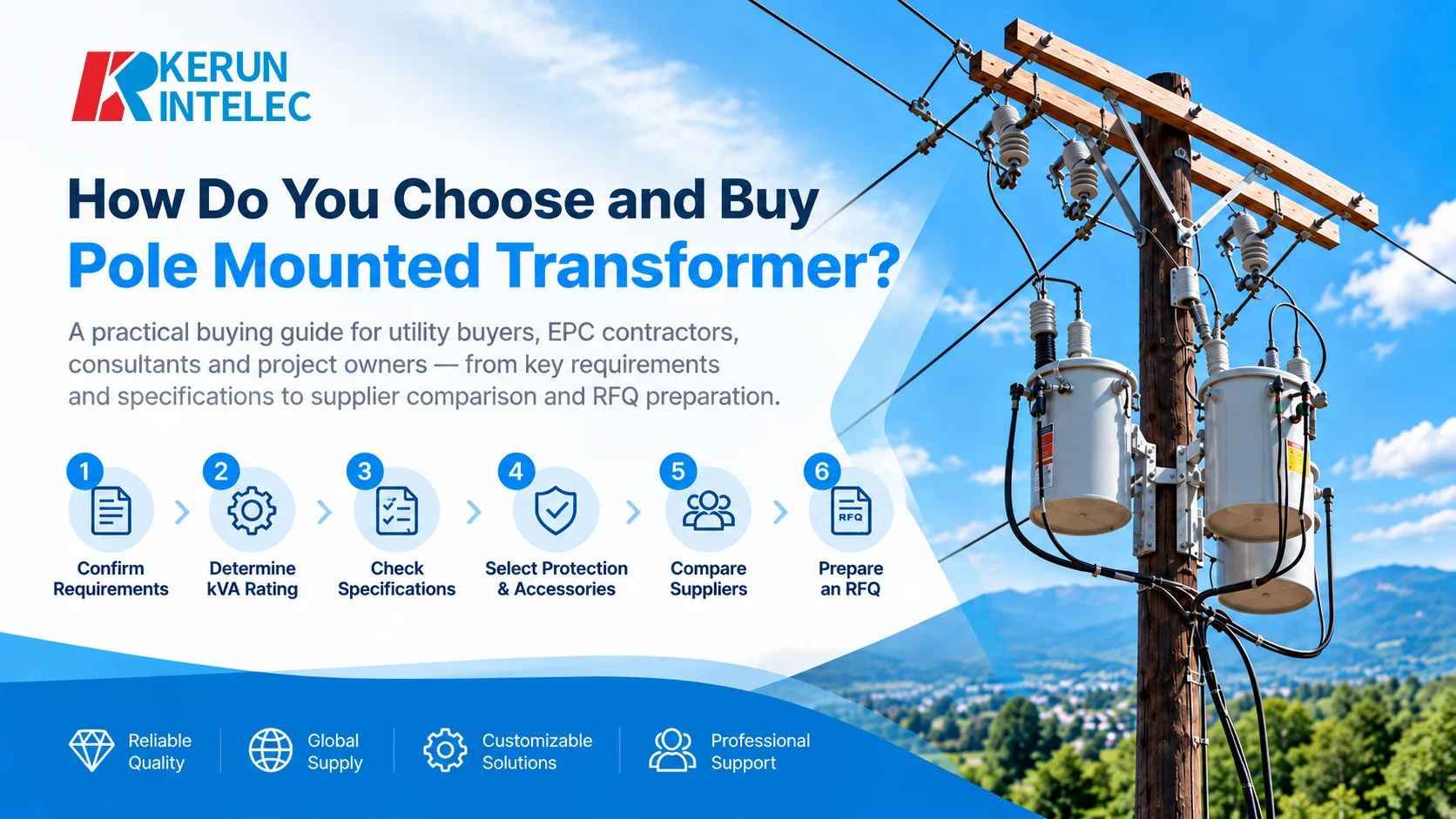
1. What Should You Confirm Before Choosing a Pole-Mounted Transformer?
Before selecting a pole mounted transformer, establish who controls the specification and what the installation must achieve. Ownership, approval and installation form affect the purchasing route as much as the electrical rating. For a utility-owned service transformer, the utility may select and procure the equipment itself; a customer cannot assume that buying a unit independently will make it acceptable.
1.1 Who Will Own, Specify, and Approve the Transformer?
Identify the equipment owner, the electrical designer, the purchasing party and the organization authorizing connection. They may be different organizations. Ask whether the project requires an approved manufacturer, an approved design or both. Obtain the applicable utility documents before issuing the RFQ. For example, City of Mesa’s separate approved lists for transformer categories show why a manufacturer’s general experience does not establish approval for every product.
1.2 What Loads and Applications Will the Transformer Supply?
Describe the actual loads: homes, shops, agricultural pumps, industrial lighting or other equipment. Also record operating hours, critical loads, motor sizes and any generation connected on the secondary side. These details help distinguish a short peak from a sustained duty. A single phase pole mounted transformer may suit one service arrangement, while a three-phase load needs a compatible three-phase supply.
1.3 Is This a New Installation, a Replacement, or a Capacity Upgrade?
Start a new installation with the single-line diagram and approved network design. A replacement enquiry also needs the existing nameplate, terminal diagram, photographs and mounting dimensions. For an upgrade, add measured demand and the proposed load increase. Because greater capacity can change available fault current, conductor duties and pole loading, review those effects before ordering.
1.4 When Is Pole Mounting More Suitable Than Pad Mounting?
Pole mounting commonly fits an overhead network where an approved pole structure and suitable clearances are available. By contrast, pad mounting may fit an underground supply or a site with different access and layout needs. Compare the complete installation: civil works, conductor routes, protection, public access, maintenance and utility acceptance. The less expensive transformer is not necessarily the less expensive installed system.
Technical names should also be clear before the enquiry goes out.
| Term a buyer may encounter | How to interpret it |
|---|---|
| Pole transformer or pole top transformer | Describes pole-mounted equipment, without defining its electrical configuration |
| Pole mount transformer or pole type transformer | Common alternative wording; the specification still needs ratings and interfaces |
| Overhead transformer or overhead distribution transformer | Refers to equipment serving an overhead distribution arrangement |
| Telephone pole transformer | An informal search phrase; distinguish the electrical power transformer from telecommunications equipment |
For an enquiry to Kerun, send the utility specification and existing drawings or nameplate photographs at the outset. Then ask Kerun to return a clarification list covering unresolved details. This makes missing information visible before either party treats the price or production schedule as firm.
2. How Do You Determine the Required kVA Rating?
Size the pole mounted transformer from the expected electrical duty, then check starting performance, thermal conditions and the utility’s loading policy. Connected load alone rarely describes how a service operates. Equally, a historic billing peak may omit a new motor, future EV charging or reverse power from solar generation.
2.1 What Load Data Do You Need to Estimate Transformer Capacity?
Request the most useful evidence available: interval demand data, recent peak records, an equipment schedule and operating hours. For a replacement, record the reason for changing the original rating. Then separate measured data from estimates. Note which loads can run together, which operate intermittently and which cannot tolerate a significant voltage dip.
2.2 How Do Maximum Demand, Load Diversity, and Power Factor Affect Sizing?
kW measures real power; kVA measures apparent power. For a defined load condition, estimate apparent power by dividing kW by the applicable power factor. Diversity and demand allowances must come from the project’s calculation method or measured behavior. Do not apply another demand reduction to figures that already account for diversity.
2.3 How Do Motor Starting and Cyclic Loads Affect the Required Rating?
A motor can place a brief but demanding duty on the supply during starting. Ask for starting current, starting method, frequency of starts and the acceptable voltage dip. For example, pumps, compressors and cyclic machinery may need a closer study than their running kW suggests. Power Partners distinguishes its T-connected and Triplex designs for particular motor duties, showing why the offered construction also matters.
2.4 How Should You Account for Harmonics, EV Charging, Solar, and Future Growth?
Include sustained charging demand, nonlinear loads, load imbalance and generation export in the duty description. Harmonics can increase heating, and solar generation can introduce reverse-power and voltage-control questions. Also keep future growth identifiable: state the proposed additional load and timing. An arbitrary spare-capacity percentage is a poor substitute for a development plan.
2.5 When Should an Engineer or the Utility Review the Proposed kVA Rating?
Seek a formal review when data are incomplete, motors are large relative to the supply, loading is unusual or the environment differs from normal service conditions. In addition, existing poles and parallel installations deserve special attention. Loading guides address temperature and insulation ageing; they do not create a universal permission to operate every transformer above its nameplate.
For initial checks, use consistent units and voltage definitions:
- Single phase: kVA = V × A ÷ 1,000.
- Balanced three phase: kVA = √3 × line-to-line V × line A ÷ 1,000.
For example, an illustrative 90 kW demand at 0.90 power factor corresponds to 100 kVA at that operating point. It does not, by itself, establish the purchase rating. Starting duty, operating temperature, growth, supply voltage and the chosen design still need review.
3. Which Transformer Configuration Fits Your Distribution System?
Choose the supply arrangement before comparing pole mounted transformer models. Different configurations can provide the same total kVA, but their mounting, protection and replacement requirements differ. An overhead transformer quotation must identify whether it covers one complete unit or a bank assembled from separate transformers.
3.1 Do You Need a Single-Phase or Three-Phase Supply?
Confirm the service required by the load and the primary supply actually available. A single-phase service and a three-phase service are different purchasing requirements even when their total apparent power is similar. Therefore, specify phase on both sides where needed. The number of visible primary bushings alone cannot establish the full electrical arrangement.
3.2 Should You Use One Three-Phase Unit or a Bank of Single-Phase Transformers?
Compare the approved alternatives for your network. A three-phase unit may offer a compact assembly, while a bank can support different replacement and spare-unit strategies. Also account for total filled weight, pole space, connections, protection and outage planning. ERMCO publishes three-phase pole-mount constructions as well as single-phase products; the choice is broader than a single can size.
3.3 How Do Wye, Delta, and Open-Delta Connections Affect Selection?
The connection determines available secondary voltages, neutral arrangements and phase relationships. Open-delta operation also changes the capacity and loading of a bank. Record the intended service, grounding and single-phase loading explicitly. For this reason, provide a diagram rather than a verbal instruction such as “three transformers for three phase.” Have the designer confirm the permissible bank duty.
3.4 What Must Match When Replacing a Unit in an Existing Bank or Parallel Installation?
Match the required voltage ratio, tap position, polarity, phase relationship, impedance and terminal arrangement. If you plan parallel operation, also check the conditions for sharing load. A replacement with the same kVA can still be electrically unsuitable. Provide the complete bank or parallel-system drawing so the review covers how the unit will operate with its neighbors.
| Arrangement | Procurement question to resolve |
|---|---|
| Single phase pole mounted transformer | Does its winding and terminal arrangement match the required service? |
| Three-phase unit | Are connection group, neutral and phase displacement correct? |
| Bank of single-phase units | Are individual ratings, connections and replacement requirements defined? |
| Open-delta bank | Has the usable bank capacity and actual load balance been checked? |
A pole type transformer is not a separate electrical phase category. Mounting form and electrical configuration need their own entries in the data sheet.
4. Which Electrical Specifications Must You Confirm Before Ordering?
Turn the network description into a complete set of guaranteed electrical data. Primary and secondary voltages are only the starting point. Frequency, connection, insulation, impedance and terminals also affect whether the proposed pole mounted transformer suits the network and acceptance requirements.
4.1 How Should You Specify the Primary Voltage and Network Grounding Arrangement?
State the nominal system voltage, whether it is line-to-line or line-to-neutral, and how the primary winding connects. Identify the system grounding arrangement and any restrictions on a grounded-wye rated design. However, a feeder described as 13.2 kV does not, by itself, identify the required winding voltage or insulation arrangement. Attach the utility’s connection requirements.
4.2 Which Secondary Voltage, Neutral, and Service Arrangement Does the Load Require?
Write the full service arrangement, including neutral and terminal configuration. A 120/240 V single-phase center-tapped service is different from a 400/230 V three-phase service. Confirm the load’s actual requirement and identify conductor material, number, size and connection method. If you list alternative secondary voltages, state which arrangement the supplier must provide.
4.3 Which Frequency and Voltage-to-Frequency Limits Must the Design Meet?
Specify the operating frequency at the RFQ stage. A transformer changes voltage without changing the incoming frequency. Applying a 60 Hz design at 50 Hz requires manufacturer assessment of voltage-to-frequency ratio, heating and usable rating; matching the voltage ratio is insufficient. Schneider’s published examples concern particular products; they do not establish approval for another manufacturer’s liquid-filled design.
4.4 Do You Need Voltage Taps, Dual-Voltage Windings, or Voltage Regulation?
Define tap range, step size, required operating position and the rating conditions for each voltage arrangement. A dual-voltage winding needs an approved connection scheme. A de-energized tap changer does not provide on-load regulation. The qualified operating team must follow its prescribed isolation procedure before changing a tap. If the project requires automatic regulation, specify that function separately.
4.5 Which Insulation Level and Lightning Impulse Rating Does the Project Require?
The designer should select insulation levels through the applicable system and insulation-coordination requirements. State the required lightning impulse level, power-frequency withstand and relevant bushing characteristics. The governing specification determines whether BIL or LI terminology applies. The IEC insulation and bushing standards have defined scopes; the project must establish which requirements apply.
4.6 How Do Impedance and Voltage Regulation Affect Fault Current and Performance?
The impedance of a pole mounted transformer affects both voltage drop and the fault current available from the transformer. Request the guaranteed percentage, its reference base and temperature, and the permitted tolerance. The protection study must also consider upstream impedance and the rest of the system. An impedance value without its reference conditions is an incomplete comparison.
4.7 Which Polarity, Phase Displacement, and Terminal Markings Must You Confirm?
For a single-phase unit, confirm polarity and the terminal diagram. For a three-phase unit or bank, confirm connection group or phase relationship, phase sequence and neutral arrangement. Ask for nameplate and terminal drawings that agree with the approved data sheet. Resolve discrepancies before manufacturing, especially where a unit must replace existing equipment.
Kerun lists configurable electrical and material options for its single-phase range. Use that flexibility to request the required service arrangement, then have the quotation record the selected design’s guaranteed values and deviations. The practical benefit is a written check against the network, rather than an assumption based on a catalog description.
5. Which Standards and Approvals Apply in the Destination Market?
A standards list for a pole mounted transformer is useful only when it matches the product, destination and contract. Identify the governing specification, its edition and any utility additions. Also keep product approval, test evidence and energy-efficiency obligations as separate acceptance questions.
5.1 Which IEEE, IEC, or Local Transformer Standards Apply to the Project?
Choose the standard family required by the destination and purchaser. IEEE C57.12.00 provides general requirements for liquid-immersed transformers, while IEC 60076 is a series covering different aspects of transformer requirements. Therefore, state the applicable parts and editions. If two documents conflict, the contract should establish precedence and require the supplier to declare the deviation.
5.2 Does the Selected Standard Cover the Proposed Phase, Frequency, and Rating?
Check the public scope before writing a standard into the RFQ. IEEE C57.12.20-2023 addresses specified overhead-type, liquid-immersed, self-cooled distribution transformers with stated rating, voltage and 60 Hz conditions. Those boundaries are the scope of that standard; they are not a global maximum rating for all pole-mounted designs. Other markets and products may require a different specification.
5.3 Which Energy-Efficiency Rules Apply to Manufacture and Supply?
Check the rules for the destination, product class and relevant manufacturing or supply date. The DOE page reviewed for this guide lists April 23, 2029 as the compliance date for the amended U.S. standards, alongside current requirements. Its 2026 request for information is not, by itself, a repeal. Australian buyers should check applicable Energy Rating requirements; European buyers should verify the applicable Ecodesign rules and amendments.
5.4 Does the Utility Require Approved Manufacturers, Type Approval, or Specific Interfaces?
Ask whether approval covers the manufacturer, manufacturing location, design and exact configuration in the offer. However, a previous supply to a utility may concern a different product. SP Energy Networks’ approval documentation illustrates the role of design assessment against network specifications. Also establish whether the project requires approval before tender submission, order placement or connection.
5.5 Which Certificates and Test Reports Demonstrate Compliance?
Request documents that answer specific questions. A quality-management certificate concerns the management system; a design or type-test report concerns tested equipment; a routine report concerns the delivered unit. If the project requires product certification, confirm its scope and model coverage. Certification logos on a web page do not establish approval for every rating and accessory combination.
| Document | What to establish before acceptance |
|---|---|
| Governing specification | Edition, product scope and utility supplements |
| Product certification | Applicable requirement, model coverage and valid record |
| Design/type-test evidence | Relationship between the tested and offered designs |
| Routine test report | Delivered serial number, results and acceptance criteria |
| Utility approval | Approved design, factory and configuration |
| Efficiency documentation | Correct market, product class, date and test basis |
Confirm the publication and contractual status of standards during procurement. For example, the public IEEE C57.12.90-2026 record reviewed for this article shows 2026 approval information while its title includes “Approved Draft.” Instead of requesting “the latest standard,” agree on an identifiable edition.
6. How Do Site Conditions and Mounting Requirements Affect the Design?
Define the site’s service conditions and mechanical interfaces, then ask the manufacturer to confirm its design guarantees. A pole mounted transformer that is electrically suitable still needs an approved supporting structure, adequate clearances and a design appropriate for temperature, altitude and exposure.
6.1 How Do Ambient Temperature, Altitude, and Solar Exposure Affect the Rating?
Give the supplier the actual minimum and maximum temperatures, altitude and any unusual solar exposure. Ask whether the quoted rating applies without adjustment under those conditions. If not, request the required design change or derating basis. Assess temperature-rise requirements and loading limits together because a standard catalog environment cannot represent every installation.
6.2 What Corrosion Protection and Insulation Design Does the Environment Require?
Describe coastal salt, industrial contamination, humidity and other exposure. Define the coating system and relevant acceptance requirements rather than asking for “anti-corrosion paint.” Consider tank material, external hardware, bushing insulation and wildlife protection as appropriate. The enclosure-integrity standard and the utility’s environmental specification can address different parts of this assessment.
6.3 Which Cooling Method and Temperature-Rise Limits Should You Specify?
State the required cooling arrangement, fluid and temperature-rise limits, with their reference conditions. Higher permissible thermal performance depends on the complete insulation system and design. However, selecting a different fluid does not automatically authorize a higher kVA rating. Ask the supplier to explain any proposed change and provide the design and test evidence required by the contract.
6.4 Will the Dimensions, Filled Weight, and Mounting Brackets Fit the Pole Structure?
Obtain the filled mass, dimensions, center of gravity, mounting details and lifting information for the actual pole mounted transformer design. The pole’s structural reviewer also needs conductor loads, wind effects and data for other equipment alongside those values. A smaller-looking tank is not evidence of a lighter installation. Check the approved support arrangement before accepting a larger replacement.
6.5 Which Clearances, Bushing Positions, and Cable or Conductor Interfaces Must Match?
Coordinate primary and secondary bushing locations with the line arrangement and working access. Specify connector compatibility with conductor material, size and number. Confirm electrical clearances against the approved design and local requirements. However, neither a supplier photograph nor a generic internet installation diagram can replace the project’s dimensional and clearance checks.
For a Kerun replacement enquiry, include bracket spacing, bushing orientation and pole-loading limits with the nameplate. Request an outline drawing for approval against those interfaces. This puts the fit check before production and reduces the risk of discovering a mounting conflict at the delivery site.
7. Which Protection Devices and Accessories Should You Specify?
Define protection as a coordinated system, then identify which devices the transformer supplier includes. The words “self-protected” do not remove the need to check the feeder, earthing and installation requirements. A clear accessory schedule prevents both omissions and unnecessary duplicated equipment.
7.1 Should You Choose a Conventional or Completely Self-Protected Transformer?
A conventional pole mounted transformer generally relies on protection specified for the installation, although individual designs can include particular protective devices. A CSP pole mounted transformer incorporates a defined protective package. Eaton describes internalized protection in its CSP range, but buyers must still identify the actual devices, ratings and coordination requirements of the offered model. Use the conventional arrangement where it matches the utility’s external protection scheme. Consider CSP where the utility approves the integrated package, the protection study demonstrates coordination and the operator can maintain the fitted devices.
7.2 Which Primary Fuses, Cutouts, Surge Arresters, and Secondary Protection Does the Installation Require?
List the required primary fuse or protective link, cutout, surge arrester and secondary protection. Assign supply and installation responsibility for each item. Have the protection designer check fault levels, loading, starting duties and insulation coordination. An included arrester or fuse does not establish that it is suitable for the destination network.
7.3 How Should You Specify Tank Grounding, Neutral Connections, and Earthing Interfaces?
Distinguish the tank bond, neutral connection and arrester-earth arrangements in the drawings. Their relationship depends on the network earthing design and local rules. SP Energy Networks publishes specific arrangements for its own system; do not apply them as universal distances or connections for other utilities. Obtain the approved project scheme.
7.4 Which Pressure, Fluid-Level, Temperature, and Fault-Indication Devices Should You Specify?
Consider pressure relief, liquid level, temperature indication and internal-fault indication according to the design and utility specification. Some devices are standard on one model and optional or unnecessary on another. Define function, visibility, operating range and any signalling requirement. Monitoring can support an asset-management plan, but its value depends on the decisions the operator will make from the data.
7.5 Which Bushings, Connectors, Brackets, Valves, and Wildlife Guards Does the Offer Include?
Check terminal current ratings, connector range, bushing configuration, mounting hardware and grounding terminals. Identify any drain or sampling facility, external operating handle, wildlife cover, lifting provision and identification label required. Use a line-item schedule showing quantity, rating, installation location and supplying party. “Standard accessories included” leaves too much scope for disagreement.
| Decision | Conventional pole mounted transformer | CSP pole mounted transformer |
|---|---|---|
| Included protective devices | Must be identified individually | Integrated package must be identified individually |
| External coordination | Defined by the approved network design | Still checked against the approved network design |
| Evaluation basis | Complete installed protection scope | Complete installed protection scope |
| Maintenance | Devices and procedures applicable to the design | Includes the fitted protective devices and their procedures |
Kerun publishes conventional and CSP offerings and a protection-device matrix. Ask which combination Kerun includes in the proposed unit, then carry the agreed list into the order. That gives the buyer a checkable supply boundary instead of relying on a product label.
8. What Factors Affect the Price of a Pole-Mounted Transformer?
The price of a pole mounted transformer depends on its electrical design, guaranteed performance and scope of supply. Capacity matters, but it does not explain the whole quotation. Two units with the same kVA can have different winding materials, insulation levels, losses, protection devices, tests and delivery obligations.
Before comparing manufacturers, establish which requirements are mandatory and which are optional. Then separate the equipment price from freight, inspection and other project costs. This makes it easier to identify a real saving and an offer that simply leaves out required work.
8.1 How Does the Required kVA Rating Affect Transformer Price?
Rated capacity affects conductor requirements, core design, insulation, cooling and the mechanical assembly. A larger rating generally requires more material and manufacturing work, although the cost does not rise at a fixed amount per additional kVA.
For example, a 25 kVA unit and a 167 kVA unit represent different duties and designs. A price-per-kVA comparison can help organize a budget, but it cannot show whether either unit is suitable or whether the quotations cover equivalent equipment.
What buyers should confirm:
- Required capacity and the load basis used to select it.
- Single-phase or three-phase service.
- One complete three-phase unit or a bank of single-phase units.
- Starting duty, environmental conditions and planned load additions.
Therefore, select the rating from the approved duty. If a lower-priced alternative changes the capacity or configuration, have the responsible engineer review the change before treating it as an acceptable saving. The earlier kVA sizing section explains the inputs needed for that review.
8.2 How Do Voltage, Frequency, and Insulation Requirements Change the Price?
Primary and secondary ratings affect the winding design and connections. Voltage class and insulation requirements also influence dielectric clearances, bushings and the insulation system. A higher insulation requirement can therefore change the construction even when the kVA remains unchanged.
Other specifications that can change the quotation include:
- Operating frequency and the required primary connection.
- Secondary voltage, neutral and terminal arrangement.
- Lightning impulse level, expressed as BIL or LI where applicable.
- Impedance, tap range and dual-voltage connections.
- Utility-specific interfaces and dielectric-test requirements.
The voltage written on a feeder drawing may describe the system rather than the voltage across the proposed primary winding. State whether values are line-to-line or line-to-neutral and provide the approved connection requirements.
For a Kerun enquiry, supply the utility specification, single-line diagram and any existing nameplate. Kerun lists configurable voltage and connection options; use the technical offer to establish the proposed arrangement and its deviations before comparing prices. This helps both parties identify unsuitable connection or insulation assumptions before those assumptions change the quotation.
8.3 How Do Winding, Core, and Insulating-Fluid Choices Affect the Quote?
Conductor material influences the design, but the material name alone cannot establish efficiency, reliability or service life. Copper has higher conductivity per unit cross-sectional area; an aluminum design generally needs a larger conductor cross-section to achieve comparable resistance at the same temperature and conductor length. Both require appropriate winding, joint and thermal design.
| Comparison point | Copper windings | Aluminum windings |
|---|---|---|
| Conductivity at the same temperature | Higher | Lower |
| Cross-section for comparable resistance at the same length and temperature | Smaller | Larger |
| Material density | Higher | Lower |
| Price comparison | Obtain a current quote for the complete design | Obtain a current quote for the complete design |
| Acceptance basis | Specified losses, temperature rise, impedance and required evidence | The same specified performance and evidence |
Material density does not establish the finished transformer’s shipping weight. Compare the offered units’ filled weights and dimensions. Eaton’s conductor discussion also explains why a copper winding does not automatically establish a low-loss design. Its historical price examples are not current market quotations.
Core material, grade and geometry affect no-load losses and manufacturing cost. Ask suppliers to price permitted alternatives against the same duty, then compare guaranteed losses rather than descriptions such as “premium core.”
Also include the insulating fluid in the price comparison. Mineral oil and natural ester can involve different fluid costs and design, sealing or handling requirements. Specify the accepted fluid and applicable quality standard; compare any associated changes to the complete unit. A fluid’s characteristics do not, by themselves, certify the assembled transformer.
8.4 How Do Guaranteed Losses and Efficiency Requirements Affect Cost?
An energized transformer has no-load losses even when it supplies no load. Load losses depend on current and include winding resistance losses and additional load-related losses. The limits specified for each influence how the manufacturer balances active materials, thermal performance and cost.
A tighter loss guarantee may require a different core, conductor arrangement or amount of material. As a result, the purchase price can increase while operating losses fall. The commercial value depends on the actual duty and electricity-cost assumptions.
When comparing offers, request:
- Guaranteed no-load and load losses, rather than an unexplained efficiency claim.
- The applicable frequency, reference temperature, rating and tap conditions.
- Test methods, permitted tolerances and the contractual acceptance basis.
Keep these conditions consistent across bidders. A lower loss figure from another rating or a different test basis cannot establish that the offered unit provides better value. The total ownership cost section explains how to evaluate the operating-cost difference.
8.5 How Do Transformer Configuration, Protection, and Accessories Affect Price?
A quotation must identify the complete assembly. A single-phase unit, a three-phase unit and a bank of separate transformers can carry different mounting, connection, protection and spare-equipment requirements.
The same principle applies to a conventional pole mounted transformer and a CSP pole mounted transformer. Establish the actual protection functions and devices included in the offered design. However, the CSP label does not mean that all external protection and system-coordination requirements disappear.
Ask suppliers to mark each required item as fitted, supplied separately, excluded or provided by another party. Include bushings, terminals, mounting hardware, grounding provisions, protective devices and any specified monitoring. Compare device ratings and functions as well as their presence in the accessory list.
Kerun publishes conventional and CSP single-phase offerings. Request an itemized comparison for the utility-approved arrangement so that the equipment price and any separately required protection are visible together. That gives the buyer a clearer cost basis than comparing two headline prices with different accessory packages.
8.6 How Do Standards, Testing, and Documentation Requirements Affect the Quote?
Compliance can affect design, components, production controls, testing and the records supplied with the equipment. State the governing standard, applicable editions and utility additions before requesting a firm quotation.
The priced scope may need to include:
- Required routine tests and individual reports.
- Applicable design or type-test evidence.
- New special tests where the specification requires them.
- Customer-witnessed or third-party inspection arrangements.
- Approved drawings, traceability records and final operating documents.
Distinguish existing evidence from tests or documents that the supplier must complete for this order. A request for a report is not necessarily a request to repeat the underlying test on every unit. Conversely, an existing report must be relevant to the offered design before it can satisfy the requirement.
Ask the supplier to itemize additional tests, inspections and document packages in the quotation. If you add them after accepting the price and production plan, both cost and schedule may change. Detailed acceptance questions belong in the pre-shipment tests and documents section.
8.7 How Do Customization, Standardization, and Order Quantity Affect Unit Price?
Customization can introduce design work, different components or additional verification. Examples include an unusual connection, restricted mounting dimensions, special coating, project-specific terminals or a demanding loss guarantee.
Where the project permits alternatives, ask whether an existing design meets the requirement and how its price differs from a custom version. “Standard” should mean an identifiable offered configuration, not an assumption that the manufacturer’s usual product satisfies every utility requirement.
Order quantity can affect material purchasing, production setup and engineering cost per unit. The benefit depends on how many units actually share the same design. A mixed order of different voltages, ratings and accessories may not have the same cost basis as a repeat batch.
Request separate line items by configuration, quantity and delivery batch. For repeat orders, discuss drawing revisions and permitted substitutions so that each price refers to a known specification.
8.8 How Do Lead Time, Packaging, and Delivery Terms Affect the Final Cost?
Material availability, production scheduling and inspection arrangements can affect the quotation. An urgent order may require expediting or a different transport plan, but the supplier’s actual offer determines whether a premium applies.
Confirm the event that starts the quoted lead time, such as approval of specified drawings or receipt of an agreed payment. Next, distinguish manufacturing completion from dispatch and arrival. These dates represent different parts of the project schedule.
For the cost comparison, identify:
- Export packing and any special preservation requirements.
- Delivery term, named place and applicable trade-terms edition.
- Freight, insurance, duties and taxes as allocated by the agreed terms.
- Unloading, lifting, installation or commissioning services included.
- Any separately priced inspection or expediting arrangements.
An ex-works price and a delivered price cover different obligations. Normalize the required scope before comparing totals. Keep the detailed milestone review in the delivery planning section.
8.9 How Should Supplier Capability, Warranty, and Support Influence Your Price Comparison?
A higher price is not proof of better quality, and a lower price is not proof of poor quality. Compare the evidence behind the offer: relevant manufacturing experience, control of critical processes, applicable test records, delivery commitments and support obligations.
Warranty comparisons need more than the number of years. Establish the start date, remedy, exclusions and responsibility for diagnosis, transport, removal and reinstallation. If the offer excludes field work or spare parts, make those costs visible in the purchasing decision.
The supplier review and warranty and support section provide the detailed checks. Here, use their findings to explain what each price actually buys.
8.10 When Can a Higher Purchase Price Offer Better Total Value?
Documented savings or service benefits can justify a higher purchase price when they exceed the additional cost under the project’s assumptions. Lower guaranteed losses, a more complete supply package or a compatible replacement arrangement may change the comparison.
Evaluate equipment, delivery, installation, energy losses and maintenance over a common period. A formal comparison should also use the project’s load profile, electricity-price assumptions and discounting method. Include outage or replacement exposure where material. The following chapter provides the loss-energy formula and an illustrative calculation.
Before accepting a Kerun quotation, ask for a comparison you can use: the offered configuration, guaranteed values, deviations, itemized equipment and options, delivery basis and agreed support scope. Kerun’s published configuration and service options provide a starting point; the approved quotation and contract must establish the actual commitments. This helps the purchasing team identify omitted work and compare compliant offers on the same basis.
9. How Do You Compare the Total Cost of Owning a Pole-Mounted Transformer?
Evaluate purchase price alongside the cost of operating and maintaining the transformer. An energized unit incurs no-load losses, whereas load losses change with loading. The better-value choice depends on the duty and energy costs, rather than one efficiency figure at an unspecified test point.
9.1 Which No-Load and Load-Loss Values Should Suppliers Guarantee?
Request no-load loss and load loss at the specified reference conditions, including temperature, frequency, rated basis and tap position where relevant. Distinguish the supplier’s guarantees from typical values. Also record how the tolerances apply. Use the same definitions across bids. A value taken from a different capacity or design is not evidence for the offered unit.
9.2 How Do the Load Profile and Energy Price Change Lifetime Operating Cost?
Use energized hours for no-load energy and an appropriate load profile for load-related energy. Continuous light loading can make no-load loss particularly relevant; heavier duty increases the contribution from load losses. Also include the energy tariff and any relevant utility valuation method. Squaring one annual average load does not reproduce the losses of a varying load profile.
9.3 How Should You Compare Low-Loss Design Claims and Efficiency Test Results?
Compare results at a common test basis. A claimed efficiency percentage needs its load point, power factor and reference conditions to be meaningful. Therefore, check that the test report belongs to a relevant design and that the contract’s guarantee remains binding. A description such as “energy-saving core” is not a substitute for declared loss values.
9.4 When Does a Higher Purchase Price Deliver Better Total Value?
Calculate the present value of the relevant costs using the project’s assumptions. Include purchase, transport, installation, energy losses and maintenance; evaluate outage and replacement exposure where material. USDA’s economic-evaluation guide explains the total owning cost approach. Use current project inputs rather than treating the guide’s historical assumptions as today’s prices.
A simplified energy estimate, using comparable temperature and operating conditions, is:
Annual loss energy ≈ P₀ × energized hours + Pₖ × Σ(load fraction² × hours)
Here P₀ and Pₖ are in kW, and Pₖ is the load loss at the stated rated reference condition. Harmonics, temperature variation and other departures may need a more detailed model.
As an illustrative calculation, reducing no-load loss by 50 W saves about 438 kWh over 8,760 energized hours. At an assumed energy price of USD 0.12/kWh, that is USD 52.56 per year before discounting. These are example inputs, not Kerun product guarantees or an electricity-price forecast.
10. How Do You Evaluate Pole-Mounted Transformer Suppliers?
A suitable pole mounted transformer supplier must demonstrate that it can deliver the offered design, its documentation and its contractual support. Evaluate the manufacturer behind the quotation as well as the seller signing the contract. A polished product page helps locate information; it does not replace production and test evidence.
10.1 Does the Supplier Have Relevant Manufacturing and Utility-Supply Experience?
Ask for experience with comparable ratings, voltage classes, standards and utility interfaces. Establish the manufacturing location and whether the seller manufactures, distributes or integrates the equipment. Relevant experience is more useful than a large list of unrelated projects. If the supplier provides references, confirm what it delivered and whether each reference concerns the same design family.
10.2 Which Factory Capabilities and Quality Records Should You Verify?
Review the controls that affect the finished unit: core and coil manufacture, drying, fluid handling, connections, sealing, coating, inspection and traceability. Request a quality plan proportionate to the order. During the audit, examine how the factory records and verifies requirements, including controls for purchased components and subcontracted processes. A certificate alone cannot show how the factory will control your order.
10.3 Can the Supplier Provide Traceable Test Reports for the Offered Design?
Check report identification, date, tested configuration and the relationship to the offered design. Ask how any differences affect the report’s applicability. The supplier should link individual routine results to the delivered serial numbers. Power Partners describes factory testing as part of manufacturing verification; your purchase documents should specify the evidence and acceptance basis you require.
10.4 How Should You Verify Material Declarations, Subcontracting, and Design Changes?
Record the selected conductor, core, fluid and critical accessories where they form part of the requirement. Define when substitutions or design changes need approval. Also ask which processes the factory subcontracts and how it controls that work. The objective is to prevent the accepted design from changing quietly between the quotation, approved drawings and delivery.
10.5 Which References, Service Resources, and Delivery Records Support the Supplier’s Claims?
Request verifiable references, an achievable production schedule and a clear route for technical and warranty enquiries. Also identify who handles installation questions and a damaged or failed unit at the destination. Kerun’s single-phase page describes enquiry-to-post-installation support; obtain the actual scope, response arrangements and commercial responsibilities for your order in writing.
A practical supplier review should leave you with four usable records: a compliant technical offer, an evidence register, a credible delivery plan and a defined service arrangement. Use these as procurement outputs rather than relying on an unsupported “best manufacturer” ranking.
11. What Should a Pole-Mounted Transformer RFQ Include?
An RFQ for a pole mounted transformer should give every bidder the same design inputs and the same supply boundary. Attach the governing documents, ask for guaranteed values and require a separate list of deviations. As a result, the first quotation can be more useful and require fewer later clarifications.
11.1 Which Electrical and Performance Data Must You Include in the RFQ?
State kVA, phase, frequency, primary system and winding connection, secondary service, taps, insulation levels, impedance and thermal requirements. Add loss guarantees and other performance requirements needed by the project. If the team has not decided an item, identify who will confirm it. Do not place several possible voltages in one field and leave the manufacturer to choose.
11.2 Which Drawings, Nameplate Photos, and Utility Documents Should You Attach?
Provide the single-line diagram, utility specification and the relevant installation drawing. For a replacement, include readable nameplate photographs, terminal details, mounting dimensions and any restrictions on changing the connections. Also record document revisions. If the existing nameplate and project drawing disagree, resolve the conflict with the responsible designer before accepting a replacement specification.
11.3 How Should You Define Accessories, Tests, Documents, and Spare Parts?
Use separate schedules for accessories, tests and documents. For protective devices, identify the supplying party and whether the devices arrive fitted or loose. Then list acceptable existing reports and the tests or witness points that the order requires. Define manuals, final drawings, serial records and spare parts as deliverables with agreed dates.
11.4 Which Quantity, Destination, Delivery Date, and Commercial Terms Should You State?
Specify quantity, delivery batches, destination and the required on-site date. State the requested delivery basis, named place and applicable trade-terms edition. Ask for quote validity and payment milestones. If the project requires customs documentation or particular packing, include those items before the order enters production.
11.5 What Should Suppliers Clarify If Some Project Data Is Still Missing?
Ask for a clarification register showing missing inputs, assumptions, consequences and responsible parties. A budget quotation can proceed on clearly stated assumptions, but an order needs an agreed specification and controlled changes. Require the supplier to list deviations explicitly. Silence does not confirm that it accepts every requirement.
RFQ schedule
| Category | Information to include |
|---|---|
| Project | Country, site, utility, owner, approver and application |
| Quantity and duty | Number of units, load data, motors, growth and reverse-power conditions |
| Rated configuration | kVA, phases, frequency, winding connections and neutral |
| Primary | Network L-L/L-N values, winding voltage, grounding and insulation level |
| Secondary | Service voltage, terminal diagram and conductor interface |
| Performance | Taps, impedance, losses, reference conditions, tolerances and temperature rise |
| Site | Ambient temperature, altitude, contamination and corrosion requirements |
| Mechanical | Filled weight limits, dimensions, brackets, bushing orientation and lifting provisions |
| Fluid and materials | Required fluid, conductor and other specified materials |
| Protection | Included devices, ratings and external coordination responsibilities |
| Compliance | Standards, editions, utility approvals and required certification |
| Acceptance | Inspection plan, tests, witness points and document requirements |
| Delivery | Arrival date, named destination, delivery terms, packing and shipping documents |
| Commercial | Currency, validity, payment, warranty and exclusions |
| Clarifications | Unresolved data, assumptions, deviations and approval deadlines |
Send this schedule with your Kerun enquiry and ask for the response to follow the same line items. It gives both parties a shared record of the requirements, the supplier’s offer and the open items.
12. How Do You Compare Quotations and Finalize the Purchase Order?
Compare pole mounted transformer quotations for technical compliance first, normalize the commercial scope next and negotiate the final order against both. A low price can become expensive when the missing items are necessary for acceptance. Keep the specification, approved deviations and supplier commitments together as the purchasing baseline.
12.1 How Do You Compare Guaranteed Specifications and Technical Deviations?
Build a comparison using the required value, offered guarantee, supporting document and deviation status. Treat safety, utility acceptance and essential performance as mandatory gates where the project requires them. A score should not hide a disqualifying deviation. Record the reviewer’s decision for each issue: acceptance, rejection or a request for clarification.
12.2 How Do You Put Price, Accessories, Testing, Freight, and Services on the Same Basis?
Bring offers onto a common currency, quantity and delivery basis. Include required accessories, test costs, inspection, documentation, packing, freight and services. Distinguish an excluded item from one supplied elsewhere in the project. Compare the cost of completing the package, while retaining visibility of which party carries each responsibility.
12.3 Which Payment, Warranty, and Commercial Conditions Need Negotiation?
Tie payments to clear events and the evidence needed at each stage. Review warranty dates, remedies, exclusions and responsibility for a delayed or nonconforming supply. One manufacturer’s published terms, for example, distinguish warranty periods by transformer type and start them from shipment. That illustrates why comparing only a headline number of years is inadequate.
12.4 Which Drawings and Technical Documents Require Approval Before Production?
Agree the approval sequence for the data sheet, outline and mounting drawings, terminal diagram, nameplate and inspection plan. Identify which documents release manufacturing. Set a process for subsequent changes, including their effect on price, tests and delivery. A drawing approval should have a clear scope and should not silently cancel unrelated contractual guarantees.
12.5 How Should You Define Acceptance Criteria, Loss Guarantees, and Nonconformance Remedies?
Define how the acceptance team will judge test results, including the applicable tolerances and any loss-evaluation provisions. State the route for correction, retesting, replacement or an authorized concession. Establish who can accept a deviation. The contract should make the consequences understandable before a nonconforming result appears at the factory.
| Comparison item | Offer A | Offer B | Decision required |
|---|---|---|---|
| Utility and specification compliance | Record evidence | Record evidence | Resolve mandatory deviations |
| Electrical guarantees | Record values and conditions | Record values and conditions | Compare on the same basis |
| Mounting interfaces | Approved drawing status | Approved drawing status | Confirm physical compatibility |
| Protection and accessories | Itemized list | Itemized list | Close omissions and duplication |
| Tests and documents | Included scope | Included scope | Confirm acceptance package |
| Delivered cost | Normalized total | Normalized total | Include remaining project costs |
| Schedule and support | Written commitments | Written commitments | Evaluate practical delivery risk |
Use this table to support a documented decision. Do not substitute a subjective supplier score for an unresolved electrical or approval issue.
13. How Long Does It Take to Receive a Pole-Mounted Transformer?
There is no single dependable lead time for every pole mounted transformer. The relevant schedule is the one for the agreed design, quantity, inspection scope and delivery destination. Ask the supplier to explain its lead-time calculation and the events that must occur before the clock starts.
13.1 When Does the Lead-Time Clock Start, and Which Milestones Should You Schedule?
Separate order receipt, payment, technical freeze, drawing approval, material availability, manufacturing, testing, release and shipment. State whether the promised date is ex-works or arrival at the named site. A duration quoted from drawing approval can look shorter than one quoted from purchase order receipt while producing the same arrival date.
13.2 How Do You Verify Stock Availability and Production Capacity?
For a stock pole mounted transformer, request the actual nameplate, serial identification, test records and storage history. Confirm that the unit meets the specification without unapproved modifications. For new production, ask whether the proposed schedule reflects a reserved manufacturing slot and the required materials. A general statement that a supplier has stock or spare capacity is insufficient.
13.3 Which Shipping, Packaging, Handling, and Customs Documents Do You Need?
Request a packing and shipping plan suited to the design and route. Include transport mass, lifting instructions, receiving precautions and any fluid documentation needed for handling or customs. Confirm which party arranges freight, insurance, clearance and offloading. Manufacturer instructions should govern permitted handling and storage.
13.4 Which Alternatives Should You Review When the Proposed Delivery Date Is Too Late?
Ask the engineer and utility to assess any proposed alternative: a different approved design, split deliveries, a temporary supply, rental equipment or an appropriate spare. Compare the effects on service, installation and acceptance. A shorter promise helps only if the responsible parties can approve and install the substitute within the project schedule.
| Milestone | Evidence to request |
|---|---|
| Design release | Approved data sheet and drawings |
| Production commitment | Agreed manufacturing schedule |
| Inspection readiness | Test or witness notification |
| Shipment release | Accepted test records and closed deviations |
| Dispatch | Packing list and shipment identification |
| Arrival | Delivery documentation and receiving inspection |
14. Which Tests and Documents Should You Review Before Shipment?
Before shipment, verify that the manufactured pole mounted transformer and its records meet the approved purchase requirements. Factory acceptance testing is an agreed inspection and acceptance activity. However, that label alone does not require the manufacturer to repeat every possible test on every unit.
14.1 Which Routine Tests Must the Manufacturer Perform on Each Transformer?
Use the governing standard and purchase specification to define the applicable routine program. Depending on the design and requirements, it can include resistance, ratio, polarity or phase relationship, losses, impedance, dielectric and leak-related checks. State the acceptance criteria and the individual records required. Identify which results must be traceable to each delivered serial number.
14.2 When Does the Project Require Type, Design, or Special Tests?
Identify design or type evidence separately from routine production tests. Temperature-rise, impulse, short-circuit and other testing have defined purposes and contractual requirements. Establish whether an existing report meets the requirement or the project needs a new test. A report for a different design requires an applicability assessment, not simply a matching manufacturer name.
14.3 Do You Need Factory Inspection, Witness Testing, or Third-Party Verification?
Set inspection and witness points according to the procurement specification and project risk. Agree the notice period, records to be available, test sequence and handling of a missed witness date. If the project requires a third party, establish its role and authority. Inspection attendance does not replace the supplier’s responsibility to meet the order.
14.4 How Should You Review FAT Results and Close Nonconformities?
Compare results with the guaranteed values and agreed tolerances. Also check calculations, test conditions and the identity of the equipment. Record nonconformities with the proposed correction and required retest or disposition. Release should follow the agreed authority and process. An email saying that the equipment “passed” is less useful than a complete, reviewable record.
14.5 Which Final Drawings, Nameplates, Serial Records, and Manuals Must the Supplier Provide?
Collect final approved drawings, the as-built terminal and nameplate information, serial-number records, test reports, fluid information and the correct operating manual. Confirm supplied accessories and loose items. Because these documents support receiving, commissioning and later fault investigation, include them in the equipment delivery.
| Evidence | Question it should answer |
|---|---|
| Individual test report | Did this identified unit meet the specified criteria? |
| Design/type-test report | Does the design evidence apply to the offered construction? |
| Inspection record | Were the agreed points reviewed and findings resolved? |
| Final drawings and nameplate | What configuration has actually been supplied? |
| Packing and accessory list | What should arrive with each unit? |
| Operating manual | Which instructions apply to this design? |
Kerun’s published single-phase information describes factory tests and serial-number-linked reports. Put the required tests, witness arrangements and release documents into the order so the published capability becomes a defined acceptance package for your project.
15. What Should You Check When the Transformer Arrives?
Receiving inspection checks what happened between factory release and arrival. Compare the delivered pole mounted transformer with the approved order, then examine its condition before accepting it into storage or installation. Follow the design’s receiving instructions and the contract’s damage-reporting process.
15.1 Does the Delivered Unit Match the Approved Order and Nameplate Data?
Match the serial number to the order and report. Check rating, voltages, phase, frequency, connection, taps and the specified fluid or material declarations. Confirm the accessories, loose parts and final documents. If an item differs, record the discrepancy and obtain a disposition before the responsible party releases the unit for installation.
15.2 Are There Signs of Shipping Damage, Fluid Leaks, or Missing Components?
Look for damaged packaging, displaced parts, dented tanks, broken bushings, coating damage and evidence of leakage. Check indicated fluid or pressure conditions only as applicable to the design and manual. However, a sound-looking exterior does not resolve a suspicious condition; obtain a documented assessment.
15.3 What Evidence Should You Record Before Accepting or Reporting a Damaged Shipment?
Take clear photographs before disturbing the packaging and identify the affected unit and shipment. Record dates, observations and the parties notified. Preserve relevant transport documents and follow the agreed process for quarantine and claims. If condition is uncertain, obtain guidance before performing handling or testing that could obscure the evidence.
15.4 How Should You Store the Transformer Until Installation?
Use the manufacturer’s requirements for position, environmental protection, sealing and any periodic checks during storage. Record the storage location, duration and inspection history. Confirm who is responsible for preservation and whether extended storage changes the pre-installation checks or warranty arrangements. Do not assume that a packed outdoor unit needs no further attention.
A useful pole mounted transformer receiving record links four items: the delivered serial number, the approved configuration, condition photographs and any corrective action. Keep it with the factory records rather than in a separate logistics file that the commissioning team may never see.
16. What Must You Confirm Before Installation and Energization?
Energizing a pole mounted transformer requires an approved installation and completed handover. Purchasing should make the necessary drawings, instructions, tests and responsibilities available to the qualified installation team. Because unresolved interfaces can affect service, close them before scheduling connection.
16.1 Who Must Approve the Pole Structure, Clearances, and Installation Method?
Obtain approval from the parties responsible for the network and supporting structure. Their review should address filled weight, mounting, wind and conductor loading, clearances and access. The installation method belongs to the approved work plan and qualified team. A generic online guide cannot establish the safe arrangement for a particular site.
16.2 How Do You Verify the Grounding, Protection Settings, and Connections?
Verify the installation against the approved drawings, including tank and neutral connections, external protective devices, tap settings and conductor interfaces. Protection settings or fuse selections must come from the approved coordination design. Also record installation changes and obtain the required acceptance before the qualified team connects the equipment.
16.3 Which Site Inspections and Pre-Energization Tests Must the Project Team Complete?
The project engineer, utility and manufacturer instructions establish the site inspection and test program. Its scope depends on the unit, transport and storage history, installation and governing requirements. Agree the records and acceptance criteria in advance. Site testing is not automatically identical to the factory routine program, and unnecessary or unsuitable testing can create additional risk.
16.4 Which Handover Records and Approvals Do You Need Before Energization?
Complete installation inspection, applicable test results, final drawings, defect closure and operating instructions. Identify who accepts the equipment for operation and who authorizes energization. Provide the operating team with the relevant ratings, protection information and emergency contacts. Release for shipment, delivery acceptance and permission to energize are distinct decisions.
The handover should identify the approved design, installed configuration, completed checks and person who authorized connection. Then keep those records available for the equipment’s service life.
17. What Warranty, Maintenance, and Spare-Parts Support Should You Arrange?
Agree support in terms the buyer can use during a real problem. A warranty period, a spare-parts list and an email address do not identify who will diagnose, transport, repair or replace a failed pole mounted transformer. Define those responsibilities before the order closes.
17.1 When Does the Warranty Start, and What Does It Cover?
Ask whether warranty begins at shipment, delivery or commissioning, and whether a separate maximum period applies. Read the storage, maintenance and operating conditions attached to it. Also check what counts as a defect and which costs or causes the warranty excludes. A longer headline period can provide less practical cover if important responsibilities remain outside its scope.
17.2 Who Pays for Diagnosis, Transport, Repairs, Replacement, and Field Work?
Record the notification process, evidence required and route for technical assessment. Agree responsibility for testing, site access, transport, customs, removal and reinstallation. Define repair or replacement arrangements and any response commitments that matter to the service. Avoid assuming that an equipment warranty automatically covers all field costs or interruption losses.
17.3 Which Spare Parts or Standby Units Are Worth Stocking?
Base the decision on service criticality, restoration time, interchangeability and replenishment lead time. Replacement bushings or protective devices may need design-specific identification. A standby unit requires its own preservation and inspection arrangements. Consider whether a common spare can serve several installations, rather than buying an identical package of spares for every unit.
17.4 Which Inspection, Maintenance, and Technical-Support Records Should You Keep?
Maintain nameplates, serial records, drawings, test results, load information, inspections and abnormal-event history. Follow the operating organization’s plan and the manufacturer’s instructions for the design and fluid. Oil-condition guidance, for example, has a defined scope and should not become an indiscriminate sampling schedule for every small sealed unit.
When agreeing Kerun after-sales support, specify the required documents, contact route, spare-part identification and division of field costs. These are concrete matters to settle in the quotation and contract. These details give the buyer a service plan to use after installation.
18. What Other Questions Should You Resolve Before Placing an Order?
Some pole mounted transformer purchasing questions remain even after the main specification is complete. Resolve these situations explicitly; each can change the price basis, approval route or acceptance package.
18.1 Can You Request a Budget Quote Before Final Design Approval?
Yes, provided the quotation clearly states its assumptions, exclusions and validity. Label it as a budget estimate and identify what could change the price or schedule. Before ordering, replace assumptions with approved data or formally accepted conditions. Keep budget approval separate from authorization to manufacture.
18.2 What Should You Do If the Offered Model Is Not on the Utility’s Approved List?
Ask the utility whether it permits an approval submission or equivalent-design assessment and what evidence it needs. Confirm the expected timing and who owns the process. If you cannot obtain approval for the design within the project’s conditions, select an acceptable alternative. A supplier’s assurance cannot replace the utility’s acceptance.
18.3 When Is a Spare Transformer Worth Buying with the Main Order?
Consider it when the cost or duration of an outage justifies the purchase, storage and upkeep of a compatible spare. Also check whether a standard unit can cover several sites. Agree interchangeability and preservation requirements before adding it to the order. The decision should follow an asset-recovery plan rather than a generic recommendation.
18.4 Can a Refurbished Transformer Meet the Project’s Acceptance Requirements?
Only if the specification, owner and utility allow it. Establish provenance, condition, fluid and contamination requirements, inspection and test scope, traceability and warranty. Age or a new coat of paint cannot demonstrate suitability. Evaluate the accepted risks and remaining evidence before comparing the price with a new conventional pole mounted transformer.
Ready to prepare your enquiry?
Send Kerun the project location, utility requirements, kVA, primary and secondary arrangement, phase, frequency, quantity and required arrival date. Include drawings and existing nameplate photographs where available. List any information still awaiting approval and ask for a technical offer with guaranteed values, deviations and an itemized supply scope.
Discuss your project with Kerun. A useful next step is a documented specification and clarification list that your engineer, utility and purchasing team can review together.